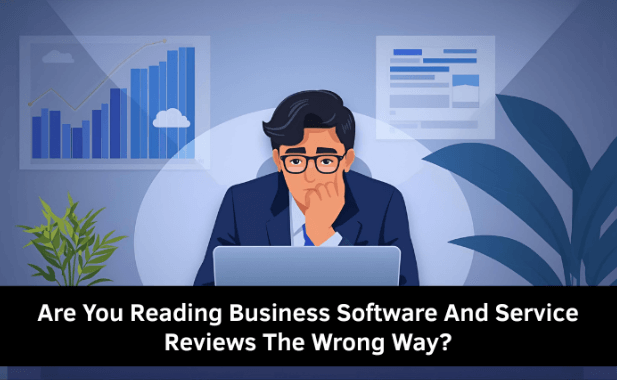
Every business leader knows the routine—before committing to any tool, you scroll through reviews, star ratings, and testimonials. It feels like doing your homework before investing. But what if the very process you trust is steering you wrong? What if business software and service reviews aren’t just about what’s written—but how you read them?
Choosing software has never been simple, and the wrong decision can waste both time and budget. Reviews are meant to simplify that process, yet too often, they’re read at face value. To truly benefit, you need to learn how to interpret them strategically—beyond numbers, beyond praise, and beyond frustration. Let’s break down how to make reviews work for you, not against you, and how a smarter reading approach can completely reshape your buying confidence.
The Real Purpose Of Reviews
At first glance, reviews look like a collection of opinions. But when read the right way, business software and service reviews act as a mirror reflecting the product’s performance under real conditions. They expose what sales pages gloss over—how reliable the software is during peak hours, how fast customer support responds, or how intuitive the dashboard feels for non-technical users.
However, many readers make a common mistake—they focus on the star rating rather than the story behind it. A five-star review without context can mean little, while a three-star review filled with insights about onboarding challenges or integration quirks can be far more valuable. The true purpose of reviews is not to confirm what you want to hear, but to show what you need to know before making a decision.
Understanding this shifts your mindset entirely—and sets the stage for exploring the traps that lead most buyers astray.
How Bias Clouds Judgment?
Every review is a story told from someone’s perspective—and perspectives are rarely neutral. Some users exaggerate frustrations after one bad experience; others overpraise after a discount or referral incentive. These biases don’t make business software and service reviews useless—they simply make them human.
The problem arises when readers fail to factor in that bias. A flood of glowing reviews may make a tool look flawless, but look closer. Are reviewers from the same industry or company size as yours? A small startup’s definition of “easy setup” could differ greatly from an enterprise’s. The opposite holds true too—a frustrated review might come from someone using the software for purposes it wasn’t designed for.
To read reviews the right way, you must learn to balance perspective with context. Once you start filtering out bias, patterns begin to appear—and that’s where the truth hides. In the next section, we’ll explore how to uncover those hidden insights buried between the lines.
Reading Between The Lines
When you skim through reviews, you often see a mix of excitement, disappointment, and neutrality. But meaningful insights come from what’s said and what’s left unsaid. For example, a review that praises “great reporting tools” but stays silent on customer support might be unintentionally hinting at a weak area. Similarly, if multiple reviewers mention “regular updates,” that implies active product maintenance—a valuable clue for long-term stability.
Reading between the lines of business software and service reviews requires paying attention to tone, detail, and patterns. A vague “it works great” adds little, while “it cut invoice errors by 25% in three months” tells you how measurable the benefits really are. Always look for concrete data, frequency of mentions, and consistency in experiences.
Once you start identifying these patterns, you’ll notice something fascinating: reviews can teach you more about your own priorities than about the software itself. Which brings us to the next point—how to use reviews to define your business needs better.
Using Reviews To Clarify Your Needs
It’s common to start with a list of features you think you need. But as you read through reviews, you’ll see real users discussing struggles you never considered—such as how reporting features scale with data growth or how integrations behave after updates. These insights can reshape your checklist entirely.
Smart readers use business software and service reviews as a mirror to refine what they truly value in a product. If multiple reviewers highlight issues with customer onboarding, that tells you to prioritize tools with guided training. If others emphasize flexible pricing, it reminds you to consider long-term scalability over short-term savings.
By aligning what reviewers are saying with your internal goals, you move from reactive buying to proactive evaluation. And once your priorities are set, you can approach the next crucial stage—testing and validation—with sharper focus.
Turning Reviews Into A Testing Strategy
Many companies rush through free trials, exploring features randomly without structure. Reviews can help fix that. Before starting your trial, scan for common pain points and test them deliberately. If several users mention slow integrations, set up a quick demo integration to see for yourself. If reviews praise the analytics dashboard, test how it performs with your actual data.
When you combine trial results with what you’ve read in business software and service reviews, you gain a complete picture: how the tool performs in both theory and practice. This approach not only validates claims but also uncovers gaps that sales demos often hide.
The trial data then becomes your negotiation strength—an idea we’ll explore next, because what you read in reviews can help you secure better deals with vendors.
Strengthening Vendor Negotiations
Negotiating software contracts isn’t just about price—it’s about understanding where the vendor stands and what you can reasonably expect. Reviews provide the leverage. If business software and service reviews repeatedly mention slow support responses or billing confusion, use that feedback to request service guarantees or clarity in terms.
For example, you might say, “I noticed several users mention delays in setup support. Can we include an SLA for implementation timelines?” This approach shows vendors that you’ve done your research and expect accountability. It also builds respect, as you’re basing requests on facts, not assumptions.
Once you’ve finalized a deal, though, your relationship with reviews shouldn’t end there. The next section explains why reviews remain valuable even after you’ve made your purchase.
Learning From Post-Purchase Reviews
The best companies never stop learning from customer experiences. After adopting new software, continue monitoring reviews for updates about performance, version changes, or emerging issues. This helps you stay informed about potential improvements or risks.
Sometimes, post-purchase business software and service reviews reveal that a vendor has improved features or addressed earlier complaints. Such patterns help you evaluate whether your choice continues to deliver value or if it’s time to explore alternatives.
Moreover, leaving your own review helps others make informed decisions, completing a cycle of shared knowledge that strengthens the entire community. The next section explores why contributing your insights is just as important as reading others’.
The Power Of Giving Back
Contributing to review platforms isn’t just about sharing an opinion—it’s about shaping the future of software development. When businesses write structured, balanced reviews, they give vendors actionable feedback and future buyers clearer perspectives.
Your review might save another company from wasting money or guide a vendor toward fixing a recurring problem. In return, it raises the overall credibility of business software and service reviews across the industry.
Reliable platforms like SaasTrac encourage such genuine contributions, ensuring that reviews reflect verified use cases and real-world results. By participating, you’re not only benefiting yourself—you’re strengthening an ecosystem built on transparency and trust.
As we reach the final section, it’s time to connect all these insights and redefine what reviews truly mean in business decision-making.
Final Thoughts
So, are you reading business software and service reviews the wrong way? Maybe, but now you know how to change that. The key lies in slowing down, analyzing patterns, questioning bias, and aligning insights with your unique goals.
Reviews aren’t just a summary of satisfaction—they’re a record of experiences that can help your business avoid costly mistakes. When read intelligently, they become one of the most powerful tools in your decision-making process.
By interpreting feedback critically and cross-referencing it with hands-on testing, you transform random opinions into strategic insights. And with platforms like SaasTrac bringing together verified reviews and practical comparisons, making the right choice becomes less about guesswork and more about confidence.
Because in the end, the question isn’t whether you can trust reviews—it’s whether you know how to read them right.